.avif)

Coral Care content is reviewed and approved by our clinical professionals so you you know you're getting verified advice.
Find effective support for developmental delays, quickly.

Concerned about your child's development?
Our free screener offers guidance and connects you with the right providers to support your child's journey.
It’s completely normal to feel worried when your toddler isn’t talking as much as you expected. Speech delays affect about ⅕ of children under age five, and early support can make a huge difference. The good news? With the right information and a clear plan, most children make strong progress.
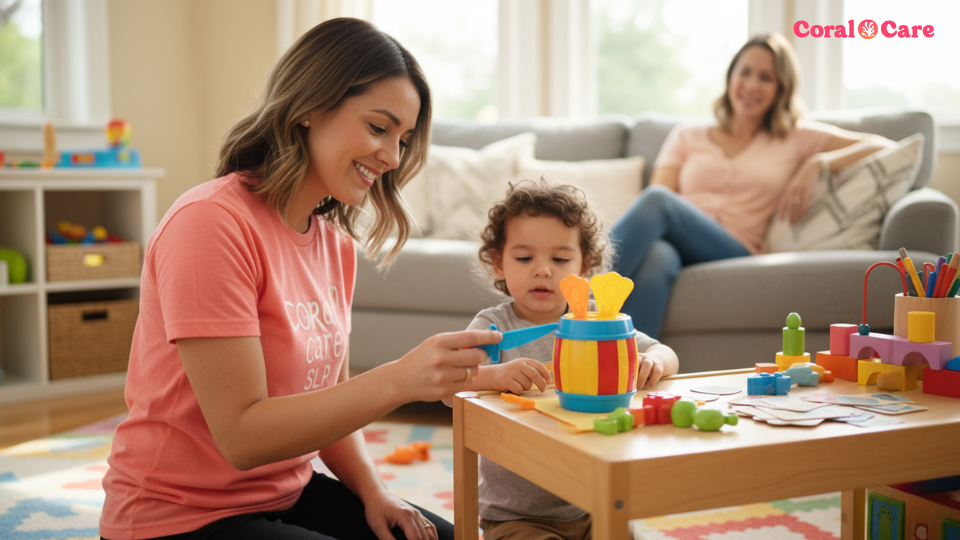
Many little ones need extra support as they find their voice, and early help can make everyday moments feel easier for your whole family. At Coral Care, we connect parents with licensed pediatric speech therapists who come right to your home, so your child can learn and practice communication skills in the environment where they feel most comfortable. We also offer free parent-friendly guides to help you understand what’s expected at each developmental stage and what support might look like.
What Is a Speech Delay?
A speech delay means a toddler isn’t using sounds or words in the way we’d typically expect for their age. It’s different from a language delay:
- Speech = how a child produces sounds and words
- Language = how a child understands and uses words to communicate
Some toddlers understand everything but struggle to say the words. Others need help with both understanding and talking. Either way, early recognition helps your child get the right support.
A common marker:
👉 Fewer than 50 words or no two-word phrases by 24 months is a sign to check in with a professional.
Typical Speech Development Milestones
Every child grows at their own pace, but here are general milestones doctors and speech therapists look for at each stage of a toddler’s development:
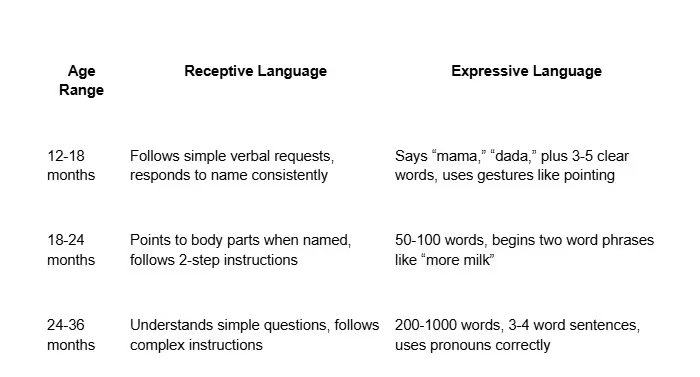
Note: These developmental milestones reflect typical patterns most children follow, though individual variation exists within normal ranges. Pediatrics guidelines emphasize that consistent progress matters more than hitting exact timelines.
If your child is falling noticeably behind these ranges, a speech-language evaluation can give clarity.
Common Causes of Speech Delay in Toddlers
Speech delay can show up for many reasons—some temporary, some ongoing. Understanding the “why” helps guide the right support.
1. Hearing Problems
Even mild hearing loss (often from chronic ear infections) can make speech sound muffled and delay learning new words. Signs include:
- Not responding to name consistently
- Saying “what?” often
- Struggling to follow verbal instructions
A hearing test is always one of the first steps.
2. Oral-Motor Differences
Some toddlers have trouble coordinating the muscles needed for speech. You may notice:
- Very unclear words
- Limited sound variety
- Difficulty chewing or swallowing
3. Autism Spectrum Disorder
Toddlers with autism may show:
- Limited eye contact
- Delayed gestures (like pointing)
- Echolalia (repeating words/phrases)
- Challenges with social communication
4. Developmental or Environmental Factors
Speech delays can also be linked to:
- Prematurity
- Global developmental delay
- Limited language exposure
- High screen time replacing face-to-face interaction
No single cause defines a child’s potential—many toddlers catch up beautifully with early help.
Red Flags: When to Seek Help
Reach out to a professional evaluation if your toddler:
- Isn’t babbling or pointing by 12 months
- Has no single words by 18 months
- Has fewer than 50 words or no two-word phrases by 2 years
- Is hard for you to understand by 30 months
- Isn’t understood by strangers by age 3
- Loses words (regression is always an urgent sign)
Trust your instincts—parents often notice concerns before anyone else.
How Speech Delay Is Evaluated
An evaluation typically includes:
1. Pediatrician
They’ll check overall development, screen for autism if needed, and refer for:
- A hearing test
- Speech-language evaluation
2. Speech-Language Pathologist (SLP)
An SLP looks at:
- Understanding of language
- Word use
- Play and social communication
- Sound production
3. Audiologist
A full hearing test rules out hearing loss—a critical step.
Some toddlers are also seen by a developmental pediatrician for deeper evaluation.
Treatment Options for Speech Delay
1. Speech Therapy
This is the most effective way to support toddlers with speech delays. Therapy for young children is playful, engaging, and tailored to their specific needs. It may focus on:
- Building vocabulary
- Improving sound production
- Encouraging back-and-forth communication
- Strengthening understanding and following directions
Parents are coached to use simple strategies during everyday routines, which leads to faster progress.
2. Early Intervention (for children under 3)
State-funded programs provide free or low-cost evaluations and therapy. They’re especially helpful if access to care is limited.
3. At-Home Support
Simple daily strategies make a real difference:
- Talk through routines (“We’re putting on shoes”)
- Read picture books together
- Expand your child’s words (“car” → “big red car”)
- Limit background noise and screens
- Offer choices (“banana or yogurt?”)
Consistency matters more than perfection!
Long-Term Outlook for Toddlers With Speech Delay
With early, consistent support:
- Many toddlers catch up to peers by preschool
- Children with hearing loss progress well once treated
- Kids with autism or developmental differences often make meaningful growth with the right team
The most important factors are early identification, high-quality intervention, and supportive daily communication at home.
Whether you’re looking for clarity, reassurance, or a clear plan forward, we’re here to help your child feel confident, understood, and connected. Coral Care makes it easy for families to get started with in-home pediatric developmental therapy, with experienced clinicians and openings available in as little as 7–14 days. You can explore our online resources, learn more about what therapy looks like, or connect with a Coral Care Concierge member who will walk you through the next steps with care and clarity.
Your child’s communication journey deserves a team that celebrates their strengths and meets them right where they are. Book an evaluation today! www.joincoralcare.com
Frequently Asked Questions
The "wait and see" approach carries real risk. The brain is most plastic in the first three years, so delaying evaluation means losing the window where intervention is most effective. If your toddler is behind, an SLP evaluation costs nothing but time and gives you clarity either way. Most insurance covers speech evaluations for toddlers.
Key signs include fewer words than expected for age, difficulty combining words into phrases, relying heavily on gestures rather than speech, frustration when trying to communicate, and being hard to understand by caregivers. Any loss of words a child previously used is a red flag that warrants immediate evaluation rather than watchful waiting.