





Coral Care content is reviewed and approved by our clinical professionals so you you know you're getting verified advice.
Find effective support for developmental delays, quickly.

Concerned about your child's development?
Our free screener offers guidance and connects you with the right providers to support your child's journey.
Parents often hear recommendations for occupational therapy, physical therapy, or speech therapy but may not fully understand what each specialty does. These therapies often overlap, share similar goals, and sometimes work together. Still, each discipline has its own focus and tools.
This guide explains the differences between OT, PT, and speech therapy in clear, parent-friendly terms so you can understand what kind of support may be right for your child.
Why Parents Get Confused
Many developmental concerns show up as behaviors long before a parent knows which type of therapist to call. For example:
- A child crashing into things
- A child who avoids handwriting
- A child who is hard to understand
- A child who tires quickly on the playground
- A child who melts down during transitions
These challenges can stem from sensory processing, motor coordination, speech clarity, or emotional regulation. Understanding how OT, PT, and speech therapy differ helps families find the right starting point and get support sooner.
What Occupational Therapy (OT) Focuses On
Occupational therapy helps children develop the skills they need for daily life at home, school, and in the community. OT is the most holistic of the three therapies, addressing a mix of motor, sensory, emotional, and functional skills.
What OT Helps With
- Sensory processing
- Emotional regulation and frustration tolerance
- Fine motor skills (drawing, cutting, writing)
- Visual motor skills
- Executive functioning
- Self-care skills (dressing, feeding, bathing)
- Play skills and social engagement
- Independence in routines
Examples of OT in action
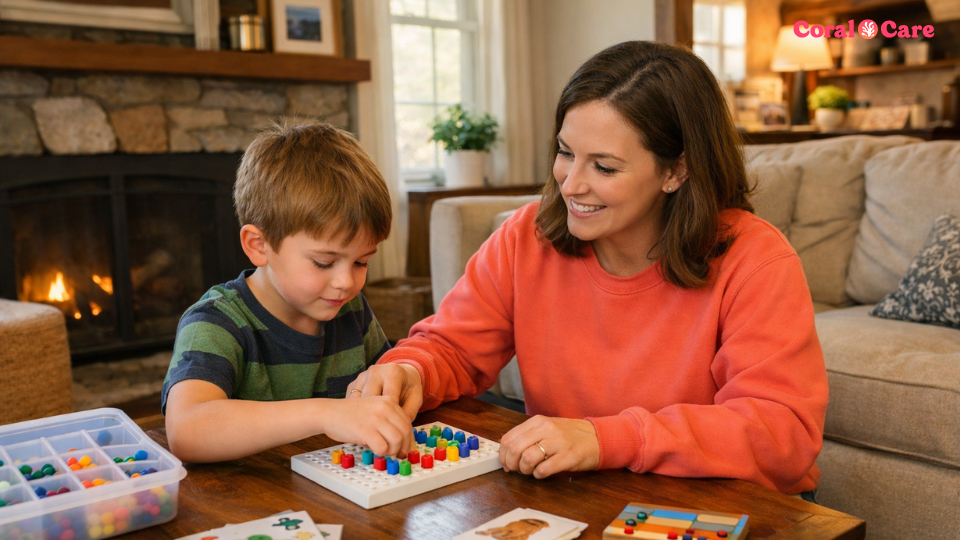
- A child who struggles with handwriting practices letter formation using fun, play-based tools.
- A child who has meltdowns during transitions learns emotional regulation strategies.
- A toddler with sensory sensitivities gradually explores textures with support.
- A child who avoids drawing strengthens hand muscles through playful activities.
OT is the best fit when daily routines feel difficult or when a child needs support with sensory, emotional, or fine motor development.
What Physical Therapy (PT) Focuses On
Physical therapy supports children in building strength, balance, coordination, and overall movement skills. PT focuses on the body’s large muscle groups and how children move through space.
What PT Helps With
- Gross motor delays
- Muscle weakness or low tone
- Balance and coordination
- Gait and walking patterns
- Endurance and strength
- Sports injuries
- Posture and core stability
Examples of PT in action
- A child who tires easily practices strengthening and endurance activities.
- A toddler who is late to walk works on balance and confidence.
- A child with coordination challenges practices skipping, jumping, or stair climbing.
- A child with flat feet or toe walking receives gait training.
PT is the best fit when concerns involve mobility, large motor skills, or physical strength.
What Speech Therapy (SLP) Focuses On
Speech therapy helps children with communication, feeding, social language, and speech clarity. Speech-language pathologists (SLPs) support how children understand and use language to connect with others.
What Speech Therapy Helps With
- Speech sound production
- Language delays (understanding or using words)
- Social communication
- Stuttering
- Early communication skills
- Feeding and oral-motor challenges
- Apraxia of speech
Examples of speech therapy in action
- A child who is hard to understand practices specific speech sounds.
- A toddler with limited words works on early communication.
- A child who struggles socially learns conversation skills and turn-taking.
- A child with feeding challenges learns to chew safely and explore new foods.
Speech therapy is the best fit when challenges involve communication, clarity, feeding, or language development.
How OT, PT, and Speech Overlap
Children are complex. Therapies often overlap because real-life skills involve multiple systems at once. A child may need two or even all three therapies depending on their developmental profile.
Some examples:
- Handwriting difficulties
OT addresses fine motor skills, visual motor integration, and posture. PT may support core strength that affects handwriting endurance. - Sensory processing and speech delays
OT may target sensory regulation, while speech supports communication skills. - Feeding challenges
OT may address sensory sensitivities or posture. Speech therapy may address chewing, swallowing, or oral motor skills. - Emotional regulation
OT helps children develop coping strategies and sensory tools. Speech therapy can help with expressive language and communication during emotional moments.
Most children receive the most benefit when therapists work as a team.
How To Know Which Therapy Your Child Needs
Here is a simple guide to help you understand where to start based on your child’s behaviors.
Start with OT if your child:
- Has frequent meltdowns or frustration
- Struggles with sensory sensitivities or sensory seeking
- Avoids drawing, cutting, writing, or fine motor tasks
- Has challenges with dressing, feeding, or independence
- Struggles with transitions or routines
- Has difficulty with organization or following directions
- Seems overwhelmed by daily life
Start with PT if your child:
- Is late to walk, crawl, or meet motor milestones
- Falls frequently or seems clumsy
- Has low muscle tone or tires easily
- Struggles with balance, jumping, running, or climbing
- Has gait concerns like toe-walking
- Needs strengthening after injury or illness
Start with Speech if your child:
- Has unclear speech or is hard to understand
- Uses fewer words than expected for age
- Struggles with social communication
- Has trouble understanding directions
- Has difficulty chewing, swallowing, or trying new foods
- Stutters or repeats sounds
- Has a diagnosis like apraxia
If you are unsure where to start, OT is often the best first step because it addresses the broadest range of developmental skills.
When Children Need More Than One Therapy
Some children benefit from a combination of OT, PT, and speech therapy. For example:
- A child with developmental delays may need OT for sensory and fine motor skills, PT for strength, and speech for communication.
- A child with autism may need OT for sensory regulation and speech therapy for social language.
- A child recovering from an injury may need PT for strength and OT for daily living skills.
A comprehensive evaluation can help you understand your child’s full profile.
How Coral Care Supports Families
Coral Care provides in-home OT, speech, and PT with licensed pediatric therapists who specialize in child development. Therapy happens in your home where your child is most comfortable, making it easier for them to learn and for families to participate.
Coral Care also helps families:
- Understand which therapy is the best fit
- Schedule evaluations quickly
- Connect with local specialists
- Receive full, ongoing support as their child grows
How To Get Started With OT, PT, or Speech Therapy
If you are noticing signs that your child may benefit from therapy, here are your next steps:
- Schedule an OT, PT, or speech evaluation
- Talk with your pediatrician
- Request school-based testing if concerns impact school success
- Contact Coral Care to get matched with a therapist near you
At Coral Care, our local pediatric therapists deliver care in the comfort of your home.
Book online. Click Get Started, call, or text: 617-463-9342
Frequently Asked Questions
Start with where your child is struggling most in daily life. Difficulty with tasks, dressing, or regulation often points to OT. Difficulty walking, coordination, or physical endurance often points to PT. Difficulty communicating, being understood, or feeding often points to speech therapy. A pediatrician can refer you for evaluations, or you can request them directly. Many children benefit from multiple therapies simultaneously.
OT focuses on daily function — self-care, fine motor skills, sensory processing, and emotional regulation. PT focuses on movement — gross motor development, balance, coordination, and physical strength. Speech therapy addresses communication — language development, speech clarity, social communication, and feeding and swallowing. They often overlap and are frequently recommended together for kids with developmental needs.

.avif)