



Coral Care content is reviewed and approved by our clinical professionals so you you know you're getting verified advice.
Find effective support for developmental delays, quickly.

Concerned about your child's development?
Our free screener offers guidance and connects you with the right providers to support your child's journey.
One of the most common reasons families start homeschooling is that the traditional classroom environment was too much for their child. The noise, the fluorescent lights, the unpredictable schedule, the transitions, the proximity to twenty-five other kids. For children with sensory processing differences, these aren't minor inconveniences. They're genuine barriers to learning.
Many homeschooling parents describe it the same way: their child stopped melting down, stopped being angry, started actually engaging with learning — once the sensory overwhelm was removed. One mom said her son with ADHD "stopped being as angry all the time, even before he started taking medicine, just because there was so much less pressure on him." His words: "I could get my work done quicker and whenever I wanted to."
At home, you have something most schools don't: the ability to control the environment. This guide will help you use that advantage intentionally — and recognize when you'd benefit from an occupational therapist's help.
What sensory processing actually means
Sensory processing is the brain's ability to take in information from the environment and the body, interpret it, and respond appropriately. When this process runs smoothly, a child can focus on a lesson without being derailed by the hum of the refrigerator, the tag in their shirt, or the feeling of their feet on the floor. When it doesn't — which is more common than most people realize — those same sensory inputs become distracting, overwhelming, or even painful.
Children can be sensory-seeking (constantly in motion, crashing into things, seeking intense input) or sensory-avoiding (overwhelmed by loud sounds, distressed by unexpected touch, refusing certain textures) — or both, in different sensory systems. Many kids are a mix of both.
Setting up a sensory-supportive learning space
You don't need a dedicated sensory room. Small, intentional adjustments make a meaningful difference.
Lighting. Fluorescent overhead lighting is one of the most common sensory triggers. Use lamps with warm bulbs where possible. If your child is sensitive to visual stimulation, position their workspace so they're facing a wall rather than a busy room.
Sound. Some children focus better in silence; others need white noise or low-fi music to block out unpredictable household sounds. Noise-canceling headphones during independent work can be transformative.
Seating. Rigid chair sitting isn't developmentally appropriate for many children. A wobble cushion, a therapy ball, a floor cushion, or simply allowing your child to stand or kneel during lessons can dramatically improve focus. Movement supports attention — that's not a workaround, that's neuroscience.
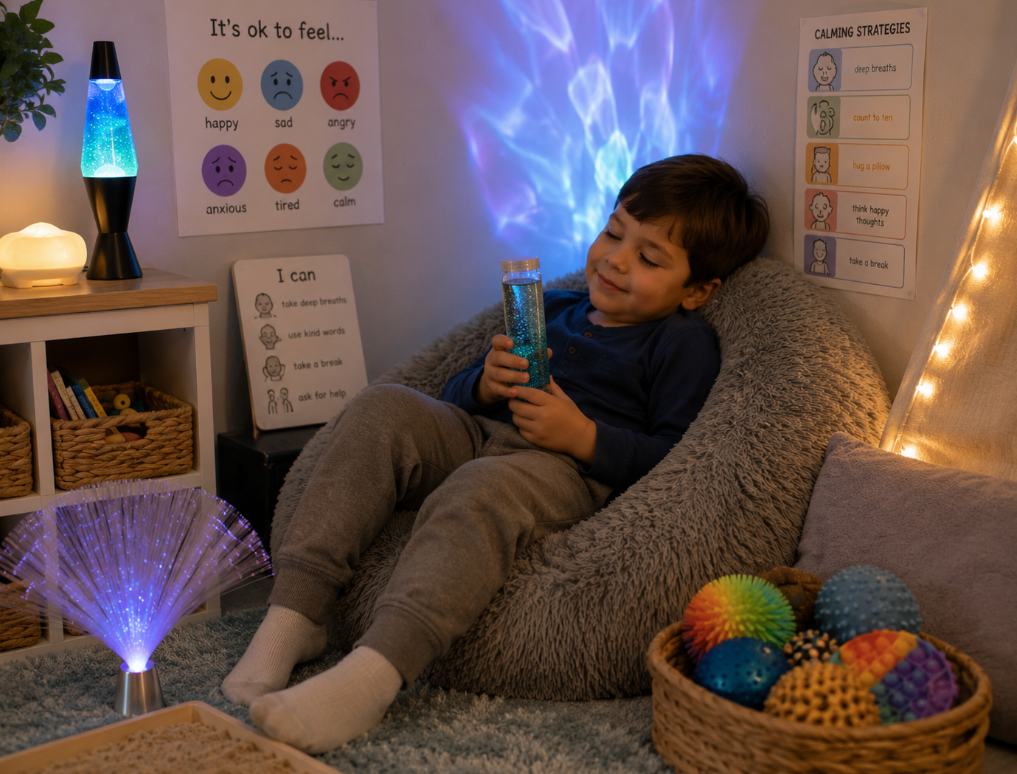
A calm corner. Every sensory-sensitive child benefits from a designated space to regulate. Not a punishment corner — a calm, low-stimulation space they can go to when they're approaching overwhelm. A weighted lap pad, noise-canceling headphones, a few fidgets they've chosen themselves. Make it inviting.
Building a sensory diet into your school day
A sensory diet is a personalized plan of sensory activities spaced throughout the day to maintain focus and regulation. The key ingredient is heavy work — activities that provide deep pressure and proprioceptive input, which is among the most regulating for most children.
Morning routine (before lessons): Five minutes of heavy work before learning demands begin makes a real difference. Animal walks, wall push-ups, carrying books from room to room, jumping on a trampoline. These activities reduce regulation challenges throughout the school day in a way almost nothing else does.
Movement breaks (every 20-30 minutes): Short, scheduled breaks prevent sensory buildup from becoming a meltdown. Make them predictable — not just offered when behavior deteriorates. A visual schedule so your child knows when the break is coming helps them hold it together until then.
Transitions: Sensory-sensitive kids often struggle more with transitions than the activities themselves. Give 5-minute and 2-minute warnings. Use a visual schedule. A brief sensory activity between subjects helps the nervous system shift gears.
Fine motor: writing, scissors, and daily tasks
OT isn't only about regulation. Fine motor skills — the small muscle movements required for writing, cutting, and manipulating objects — are also in the OT domain.
If your child avoids writing, has poor pencil grip, fatigues quickly when writing, or has difficulty with scissors, buttons, or self-care tasks, those are signs worth noting. A fine motor warmup before writing tasks makes a difference: playdough, lacing beads, tearing paper, picking up small objects with tweezers.
When an OT can help more than a blog post
The strategies here are genuinely useful. But they work best when they're built on an accurate understanding of your specific child's sensory profile. A Coral Care OT can assess which sensory systems are dysregulated, how they interact with your child's learning and behavior, and what interventions will have the most impact — for this particular child, not a general list.
Signs that suggest an OT evaluation would help: frequent meltdowns that seem disproportionate to the trigger; extreme difficulty with transitions despite consistent structure; strong aversion to certain textures, sounds, or touch; seeking intense sensory input in ways that interfere with daily life; significant difficulty with handwriting or self-care tasks like dressing and eating.
Coral Care matches homeschooling families with occupational therapists who come to your home, work within your school day, and use what's already in your environment. Sessions are play-based, affirming, and personalized. Insurance covers it for most families — Coral Care verifies your coverage before the first visit.
Find an OT near me — free to start, insurance verified before your first visit.
Frequently Asked Questions
Homeschooling gives you something most classrooms can't: the ability to control the environment. You can reduce noise, soften lighting, build in predictable routines, limit overwhelming transitions, and create a calm space to step away. Many families find their child stops melting down and starts engaging with learning once the sensory overwhelm is removed. An occupational therapist can help you tailor these strategies to your specific child.
Sensory processing is the brain's ability to take in information from the environment and the body, interpret it, and respond appropriately. When it runs smoothly, a child can focus on a lesson without being derailed by the hum of the refrigerator, a shirt tag, or the feeling of their feet on the floor. When it doesn't, which is more common than most people realize, those same inputs become distracting or distressing barriers to learning.

.avif)