
Coral Care content is reviewed and approved by our clinical professionals so you you know you're getting verified advice.
Find effective support for developmental delays, quickly.

Concerned about your child's development?
Our free screener offers guidance and connects you with the right providers to support your child's journey.
You've probably noticed more companies offering virtual occupational therapy lately, and more articles making the case that online OT "can be just as effective as in-person therapy." As a company that connects families with in-home, in-person OTs, we've read a lot of them.
We're not going to argue that telehealth is worthless. It isn't. For families with no access to care, a screen is better than nothing. But a lot of what's being published glosses over something that matters enormously if your child has real therapy needs: the physical presence of a trained therapist is not a delivery format preference. It is a clinical requirement.
Here is what the research actually says.
What OT for kids actually is
Occupational therapy covers an enormous range of what children need to do every day. Getting dressed. Holding a pencil. Eating without distress. Sitting still long enough to learn. Navigating a playground. Regulating emotions when a plan changes. Managing a body that doesn't always cooperate.
The children families bring to OT have needs that span sensory processing, fine motor skills, gross motor development, handwriting, feeding, self-care, attention, emotional regulation, visual-motor integration, motor planning, and daily living skills. What almost all of these have in common is that working on them requires a therapist who can see, touch, guide, and respond to a child's body in real time.
The dominant framework used by OTs who work with children — Ayres Sensory Integration, or ASI — targets eight sensory systems: auditory, visual, taste, smell, touch (tactile), proprioception (body awareness through joints and muscles), and vestibular (balance and movement through space). Research has since added an eighth: interoception, which is how the body senses internal states like hunger, pain, fullness, and the need to use the bathroom — a critical piece of self-regulation work in OT. A screen can reach two of those eight. The six that matter most — touch, proprioception, vestibular, smell, taste, and interoception — cannot be transmitted through a video call.
But even beyond sensory integration, consider what hands-on therapy makes possible that a screen cannot. An OT working on handwriting can feel how a child grips a pencil, feel the pressure they apply, and physically adjust their hand position. An OT working on feeding can observe the full picture of a child's oral motor function, texture responses, and body posture at the table. An OT working on dressing can physically guide a child through the motor sequence of buttoning a shirt. An OT working on fine motor skills can feel muscle tone, joint stability, and coordination in ways no camera can capture.
There's also something harder to quantify: clinical judgment in the room. A skilled OT is constantly reading how a child is responding and making micro-adjustments in real time — grading a task up or down in difficulty, modifying the environment, shifting an activity when a child is fatiguing or dysregulating. That kind of adaptive decision-making depends on physical presence. What a camera sees is not enough information to do it well.
This is not something a parent can replicate on a therapist's instruction, and it is not something a camera can see well enough to guide safely or precisely.
The telehealth argument, and the gap in it
The articles making this case tend to follow a similar pattern. They cite studies that found children make "comparable progress" in telehealth versus in-person OT. They acknowledge, briefly, that some goals may require "physical prompting or hands-on assistance" and that "specialized equipment" like swings and sensory gyms may be unavailable at home.
Then they move on, as if that acknowledgment closes the question.
It doesn't.
Here's what the research actually shows:
Telehealth OT is effective for caregiver coaching — not direct intervention. The clearest finding across multiple peer-reviewed studies is that virtual OT works best when the goal is teaching parents strategies, not delivering therapy to a child. A 2025 review published in the International Journal of Telerehabilitation was direct: the strongest evidence for pediatric OT telehealth is not in direct skill transfer — it is in caregiver coaching and home generalization. Evidence is more limited for complex motor assessment and Ayres Sensory Integration therapy requiring physical equipment.
Caregiver coaching is valuable. It is also not the same as your child receiving therapy.
OTs themselves returned to in-person as soon as they could. After pandemic restrictions lifted, researchers surveyed 132 pediatric OTs about their telehealth use. The median rate of telehealth use had dropped to just 10% of services. Studies found that once restrictions were removed, therapists returned to in-person services to avoid the challenges and barriers associated with telehealth — especially those who commonly provided hands-on interventions like sensory integration. These are the people who know the work best, and the overwhelming majority chose to go back in person the moment they had a choice.
School-age children are not exempt. These articles often say virtual OT works for toddlers because therapy "often focuses heavily on caregiver coaching." That is a reframe. When your child is receiving OT via telehealth, what is actually happening is that you are receiving coaching while you try to implement interventions you were not trained to deliver, with a child who may not understand why they should cooperate with what you are being asked to do. A 2024 research paper on digital physical therapy for children with developmental disorders found that parents showed a clear preference for face-to-face therapy and argued it should not become a generalized model of care for this population.
Platform audio and video quality are clinical problems, not inconveniences. Boston University researchers found that popular teleconferencing platforms — Zoom, Webex, Teams, and others — each have audio enhancement algorithms that create clinically significant differences from in-person sound quality. For speech therapy this is well-documented. For OT it affects how clearly a therapist can observe a child's movement quality, motor planning, coordination, and sensory responses at a distance.
Standardized assessments require in-person administration. The tools OTs use to evaluate children — the Bayley Scales, the Pediatric Evaluation of Disability Inventory, the Melbourne Assessment of Unilateral Upper Limb Function, the Pediatric Balance Scale — are standardized for in-person use. A recent scoping review confirmed that assessments requiring technical skills, specialized training, or physical interaction must be administered in person. When a virtual OT evaluates your child, they are working from a limited view, often a single camera angle, without the ability to manually assess tone, strength, or coordination.
The argument telehealth advocates make — and why in-home in-person is the real answer
The strongest argument for virtual OT is that it happens in your child's natural environment. Therapy at home means a therapist can see how your child moves through your actual space, where the real challenges live. Skills practiced in context generalize better than skills practiced in a clinic.
This is true. We agree with it completely. It is also an argument for in-home in-person care, not virtual care.
When an OT comes to your home to work with your child, they get everything virtual therapy claims — natural environment, family involvement, real-life context — and they can also do the actual therapy. They can apply deep pressure. They guide your child through balance and coordination challenges. They feel whether a child is resisting or fatiguing. They bring equipment, or they use yours more effectively than you can on verbal instruction alone. They can also read the environment in ways a camera cannot: the layout of the space, the sensory setup of the home, what materials are actually available, how family routines work, how siblings interact. That context shapes every decision a skilled OT makes, and it's only fully accessible in person.
Children feel more secure in their homes. This is real. A familiar environment reduces the anxiety that often shows up when children with sensory sensitivities have to enter unfamiliar clinical spaces. In-home therapy captures that benefit. Virtual therapy captures a camera view of it.
What virtual OT is actually good for
To be fair: there are real uses for telehealth OT, and we want to name them.
Follow-up sessions after in-person work has established a foundation. Parent training on specific home program activities. Check-ins for maintenance of skills already acquired. Consultations for families in rural areas with genuinely no access to in-person providers. These are legitimate uses.
They are not the same as a child receiving occupational therapy.
If your child is working on any of the following, they need a therapist who can be physically present:
Sensory processing and regulation. Fine motor skills — pencil grip, scissors, fasteners, handwriting. Feeding and oral motor development. Self-care skills like dressing and grooming. Gross motor coordination and motor planning. Visual-motor integration. Attention and executive function in the context of movement. Emotional regulation tied to sensory or body-based triggers.
A seven-year-old who struggles with handwriting, a five-year-old who can't tolerate certain textures at meals, a nine-year-old working on motor planning — all of them need a therapist whose hands are in the room. The nervous system does not respond to instruction alone. It responds to physical experience, repetition, and skilled guidance that cannot be delivered through a screen.
Virtual OT vs. in-home in-person OT: what's actually different
The data below comes from peer-reviewed research published in the International Journal of Telerehabilitation, a 2025 post-pandemic survey of 132 pediatric OTs, and clinical literature on Ayres Sensory Integration therapy.
The "what OTs choose" row is the one we keep coming back to. These are the clinicians who did both — who ran virtual sessions out of necessity and then, when restrictions lifted, went back to in-person. That's not a preference. That's a clinical verdict.
The research on pediatric OT is more careful than most of what you'll find on telehealth company websites. Researchers who have studied this question directly tend to land in the same place: virtual OT has a role, but it is not an equivalent substitute for in-person care when a child is actively working on sensory, motor, feeding, fine motor, self-care, or regulation goals — which describes most of the children referred for OT.
The question for your family is not whether virtual OT can produce some progress. It probably can, under the right conditions. The question is whether you want "some progress under the right conditions" or whether you want your child to receive the full intervention their developing body and nervous system actually needs.
In-home in-person therapy answers that question. Everything else is a workaround.
Coral Care connects families with licensed OTs, SLPs, and PTs who come to your home. We work across nine states, and we accept most major insurance. If your child has been referred for OT or you're wondering whether they should be evaluated, we'd be glad to help you find someone who can actually meet them where they are.
Frequently Asked Questions
In most cases, yes. Coral Care accepts most major insurance plans across our nine states. Coverage varies by plan and state — contact us and we'll check your benefits before your first session.
Convenience matters, which is exactly why in-home therapy exists. When a therapist comes to your home, you get everything telehealth promises — no commute, no waiting room, therapy in your child's natural environment, real family involvement — and your child still gets actual therapy. In-home in-person care is not a compromise between convenience and quality. It is both.
No. The need for physical guidance doesn't diminish as children get older. A seven-year-old working on handwriting, an eight-year-old with feeding challenges, a nine-year-old building fine motor strength — all of them need hands-on intervention. Virtual OT advocates sometimes frame older children as better candidates for telehealth because they can follow instructions. But following instructions and receiving therapy are two different things.
The honest read is mixed. The clearest post-pandemic data point: when researchers surveyed 132 pediatric OTs after restrictions lifted, the median rate of telehealth use had dropped to just 10% of their services. These are clinicians who did both. When they had a choice, nine out of ten went back in person. That is the research that matters most.
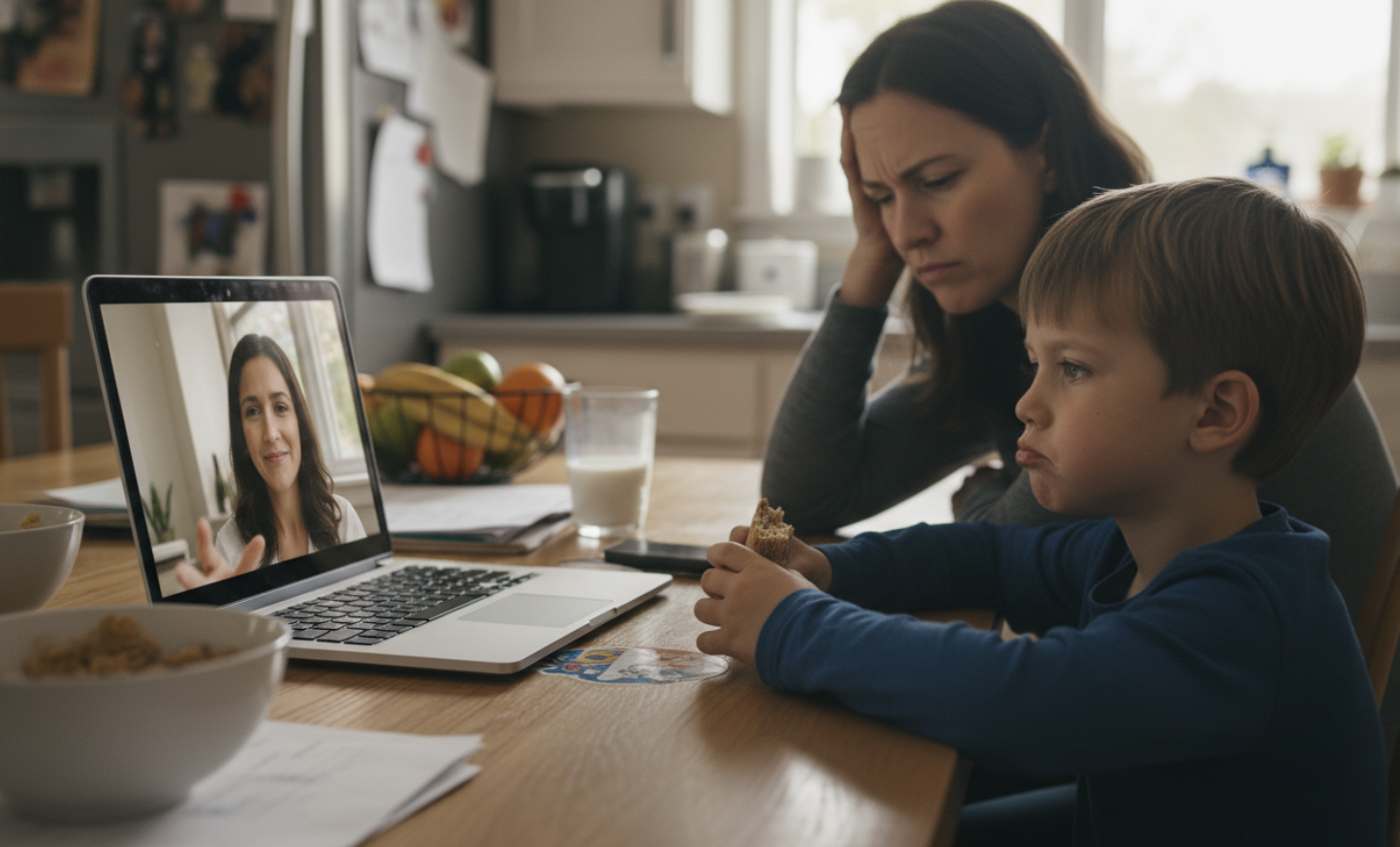
Mostly, you become the therapist. The OT watches through a camera and directs you — how to move your child's body, what input to provide, how to respond to what you're seeing. That coaching has value. But you were not trained to deliver occupational therapy, you cannot feel what a trained clinician feels, and you are also trying to be the parent at the same time. Research confirms this burden is real — studies found some caregivers reported increased stress and burnout from managing virtual OT sessions. For a child with active therapy goals, this model asks too much of parents and delivers too little to kids.
Because the work happens through the body, not through a screen. An OT working on handwriting can feel how a child grips a pencil and physically correct their hand position — a camera cannot. An OT working on feeding can assess oral motor function and texture responses up close in ways video cannot replicate. An OT working on sensory integration delivers deep pressure, vestibular input, and tactile stimulation that require physical contact. An OT working on dressing guides a child's hands through the motor sequence of buttoning, zipping, and fastening. Across almost every OT goal area, the most important clinical tool is the therapist's physical presence and hands — neither of which travels over a video call.
A lot more than most people expect. OT covers the full range of what children need to do every day: getting dressed, holding a pencil, eating without distress, sitting still long enough to learn, navigating a playground, regulating emotions when a plan changes. Specifically, pediatric OTs work on sensory processing, fine motor skills, gross motor development, handwriting, feeding and oral motor function, self-care, attention, emotional regulation, visual-motor integration, motor planning, and daily living skills. Most of these goals have one thing in common — they require a therapist whose hands are in the room.
For a narrow set of goals, yes. Telehealth OT works for teaching parents strategies, checking in on home programs, and maintaining skills a child already built through in-person work. For everything else — sensory integration, motor development, body awareness, regulation — the research is less encouraging. The clearest finding across multiple studies is that virtual OT's strongest evidence is in coaching parents, not in treating children directly. Those are not the same thing.
Virtual OT is therapy delivered over video call, where a licensed occupational therapist guides activities remotely. The therapist observes your child through a screen and coaches you or your child through exercises in real time. It expanded during the COVID-19 pandemic when in-person care wasn't an option — and for many families, it was better than nothing. But better than nothing is a low bar when your child has real sensory or motor needs.