
Coral Care content is reviewed and approved by our clinical professionals so you you know you're getting verified advice.
Find effective support for developmental delays, quickly.

Concerned about your child's development?
Our free screener offers guidance and connects you with the right providers to support your child's journey.
Your child can bend their thumb back to touch their wrist. They sit in the splits without batting an eye. Their elbows and knees seem to extend further than other kids'. Maybe a gymnastics coach has been impressed. Maybe a relative has casually said, "Wow, she's so double-jointed!"
Being extra flexible might seem like a bonus. But for some kids, excessive joint flexibility comes with challenges that aren't always obvious. Here's what parents need to know about joint hypermobility, when it's benign, and when it needs attention.
What Is Joint Hypermobility?
Joint hypermobility means the joints have a greater range of motion than what's considered typical. The ligaments (the connective tissues that hold joints together) are looser than average, allowing the joints to move beyond their normal range.
Hypermobility exists on a spectrum. On one end, you have a child who's simply more flexible than average, with no symptoms or functional limitations. On the other end, you have conditions like hypermobile Ehlers-Danlos syndrome (hEDS) or hypermobility spectrum disorder (HSD), where the excessive flexibility causes significant symptoms and affects daily life.
How Common Is It?
Generalized joint hypermobility (meaning it's present in multiple joints) is very common in children. Studies suggest it affects 10-30% of school-age kids, and it's more common in girls, younger children, and certain ethnic groups. Most children with joint hypermobility have no symptoms and no problems.
The condition often runs in families. If you or your partner are notably flexible, your child may be too.
The Beighton Score: A Quick Screen
Healthcare providers often use the Beighton Score to screen for generalized hypermobility. It checks nine points across the body:
- Can the pinky finger extend back past 90 degrees? (1 point each side)
- Can the thumb touch the forearm when bent toward the wrist? (1 point each side)
- Does the elbow hyperextend past straight? (1 point each side)
- Does the knee hyperextend past straight? (1 point each side)
- Can the child place their palms flat on the floor with knees straight? (1 point)
A score of 5 or higher in children is generally considered hypermobile. But the score alone doesn't determine whether treatment is needed. What matters is whether the hypermobility is causing symptoms.
When Hypermobility Is Just Flexibility
Many hypermobile kids do great. They may excel in dance, gymnastics, or martial arts. Their flexibility is an asset, and they have no pain, instability, or functional limitations.
Hypermobility on its own is not a diagnosis and not a problem. It only becomes a concern when it's causing symptoms.
When Hypermobility Causes Problems
For some hypermobile children, the looseness in their joints leads to challenges:
Joint pain. This is the most common complaint. Pain often occurs after activity and tends to affect the knees, ankles, and wrists. It can mimic growing pains and is sometimes dismissed as such.
Fatigue. Hypermobile kids often tire more easily during physical activity because their muscles have to work overtime to stabilize joints that the ligaments aren't supporting adequately.
Frequent injuries. Sprains, strains, and subluxations (partial dislocations) are more common in hypermobile children. Their joints are more vulnerable to injury, especially during sports.
Poor coordination and balance. Without stable joints, the body has to constantly recalculate balance and movement, which can make kids appear clumsy or uncoordinated.
Difficulty with fine motor tasks. Hypermobile fingers can make handwriting difficult, as the joints don't provide the stable base needed for precise control.
Avoidance of physical activity. When movement hurts or is harder than it should be, kids may start avoiding active play, sports, or PE class.
W-sitting. Hypermobile children often prefer W-sitting because it provides a wide, stable base that compensates for the stability their joints don't provide.
How Pediatric PT Helps with Hypermobility
Physical therapy is the primary treatment for symptomatic joint hypermobility. The goal isn't to reduce flexibility (you can't tighten ligaments with exercise) but rather to build the muscular strength and motor control that compensates for the joint looseness.
Strengthening the stabilizers. The focus is on strengthening the muscles around hypermobile joints. For the knees, this means quads and hamstrings. For the ankles, it's the peroneals and calf muscles. For the core, it's the deep stabilizers. Strong muscles act as internal braces for loose joints.
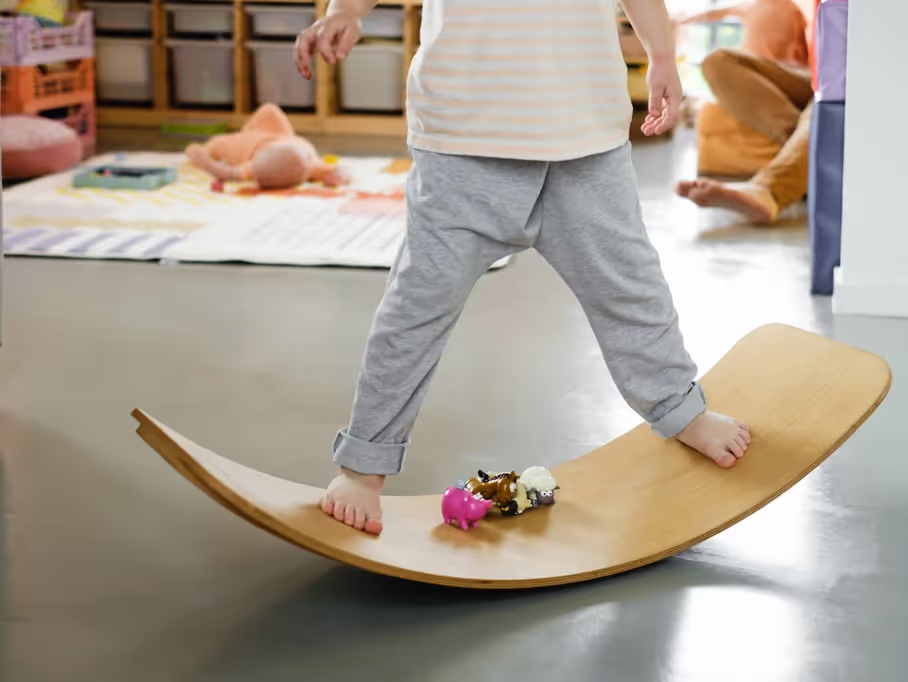
Proprioceptive training. Proprioception is your body's sense of where it is in space. Hypermobile kids often have reduced proprioception because their joint receptors get less reliable input from lax ligaments. Balance boards, single-leg activities, and eyes-closed exercises all train this system.
Joint protection education. Your PT will teach your child to avoid "hanging" on their ligaments. This means learning not to lock their knees when standing, not to hyperextend their elbows when weight-bearing, and not to use end-range positions as their default.
Activity-specific training. If your child plays a sport or instrument, your PT can help them develop the joint control needed for their specific activities while minimizing injury risk.
Pain management strategies. For kids with chronic joint pain, your PT will develop a plan that might include specific exercises, activity pacing, and education about managing pain flares.
Building endurance. Graded exercise programs help hypermobile kids build stamina without overdoing it. The key is finding the right balance between building strength and avoiding overuse.
What You Can Do at Home
- Encourage strengthening activities. Swimming is often ideal for hypermobile kids because it builds muscle without high-impact joint stress. Climbing, martial arts, and yoga (with modification to avoid extreme ranges) are also great.
- Be cautious with stretching. Hypermobile kids don't need to stretch more. They're already flexible. Focus on strengthening, not stretching.
- Watch for joint locking. Gently remind your child not to lock their knees or elbows when standing or weight-bearing. "Keep your knees slightly soft" is a helpful cue.
- Supportive footwear. Good shoes with arch support and heel stability help compensate for hypermobile ankles and flat feet.
- Pace activities. Help your child learn to take breaks during physical activity before pain starts, rather than pushing through until they crash.
- Validate their experience. If your child says something hurts after activity, believe them. Hypermobility-related pain is real, even when nothing looks wrong from the outside.
When to Seek Further Evaluation
If your child has widespread hypermobility plus significant symptoms (chronic pain, frequent injuries, significant fatigue, skin that bruises easily or is unusually stretchy, or a family history of connective tissue disorders), it's worth seeking evaluation by a geneticist or rheumatologist who specializes in hypermobility conditions.
Conditions like hypermobile Ehlers-Danlos syndrome (hEDS) and hypermobility spectrum disorder (HSD) benefit from a multidisciplinary approach that may include PT, OT, pain management, and sometimes other specialists.
The Bottom Line
Joint hypermobility is common in kids, and most of the time it's harmless. But when flexibility leads to pain, fatigue, injuries, or avoidance of activity, a pediatric PT can build the strength and stability your child needs to move confidently and comfortably.
At Coral Care, our PTs work with hypermobile kids to build the muscular support their joints need. We'll evaluate your child's specific pattern of hypermobility, identify which joints need the most support, and create a fun, play-based program that builds strength without overdoing it. Schedule a free consultation to get started.
Frequently Asked Questions
Generally no. Hypermobile kids are already flexible and don't need more stretching; the focus should be on strengthening instead. Swimming is often ideal because it builds muscle without high-impact joint stress, and climbing, martial arts, and modified yoga that avoids extreme ranges are also good. Gently cue your child to keep knees and elbows soft rather than locked, and believe them when they say something hurts after activity.
Physical therapy is the primary treatment for symptomatic hypermobility. The goal isn't to reduce flexibility, since you can't tighten ligaments with exercise, but to build the muscular strength and motor control that compensates for loose joints. A PT strengthens the muscles around hypermobile joints so they act as internal braces, trains proprioception, and teaches joint protection like not locking the knees or elbows.
Not usually. Many hypermobile kids have no symptoms and even excel at dance, gymnastics, or martial arts, where flexibility is an asset. Hypermobility on its own is not a diagnosis. It becomes a concern only when it causes symptoms like joint pain after activity, fatigue, frequent sprains, poor coordination, handwriting difficulty, or avoidance of physical activity.
Joint hypermobility means the joints move beyond their typical range because the ligaments are looser than average. It's very common in children, affecting an estimated 10 to 30% of school-age kids, and is more common in girls and younger children. It often runs in families. Most children with hypermobility have no symptoms and no problems; it only becomes a concern when it causes pain, instability, or functional difficulty.