The State of Pediatric Development 2026 — Coral Care

The State of Pediatric Development · 2026 Report

The child didn't change.Childhood did.

Kids are being identified earlier than ever — and that is real progress. But the challenges they show up with increasingly reflect a childhood that has been structurally rebuilt in a single generation, not the developmental delays our care system was designed to catch.

1,500+
families surveyed across the screener
2,000
sample size of patient intake data
700+
OTs, PTs, and SLPs in one network
3
data layers — research, families, clinicians

The argument, in four moves

What the data is telling us.

01

Childhood was rebuilt.

Home, school, and the time in between all changed at once — and none of it was chosen by parents. Families are smaller and more often dual-earner. The structure a generation grew up inside is largely gone.

88%
of public schools now assign every student a device
40%
of two-year-olds have their own tablet
7 min
of unstructured outdoor play a day
02
This is the win

So kids are caught earlier.

It is the clearest systemic improvement in a decade. Earlier identification means earlier support — when it matters most.

4.584.40 Coral Care median age at evaluation, in a single year
75 National median age of an autism diagnosis for boys
03

But they present differently. Regulation overtook speech.

By ages 5 to 12, the top concern parents raise is no longer speech. The question changed from “my child can't say what they mean” to “my child can't manage themselves in a school day.”

Top concern parents raise, by age band
Coral Care parent screener · share naming each as their #1 concern
Speech & language Emotional regulation
67% 0–2 3–4 5–7 8–12
04

And they present whole, not in single delays.

Kids arrive as whole children. The system still processes them one discipline at a time — yet the need rarely fits in a single lane.

Need two or more services
26%
Teens needing 2+ services
36%
Need all three — OT, PT & SLP
6%

The mismatch

Covered, but not served.

The care system was built for the old childhood: single-domain, speech-and-motor delays, one referral at a time. Today's kids don't fit that mold — and the system's seams are exactly where they fall through.

76%

of school-age patients have no IEP. Families are paying privately for the support schools are funded and mandated to provide.

Lost in the middle

Insured, in a school district, engaged parents — and still unable to access care. The system was built for families poor enough to qualify for public programs or wealthy enough to pay out of pocket. Most of America is neither.

A maze, by design

Insurance authorizes one service at a time, often requiring a diagnosis the child doesn't have yet. Early Intervention waits run three to six months. IEP thresholds vary so widely the same child qualifies in one state and not another.

Why Coral Care can see this

We see the places where development actually happens.

Schools see classrooms.
Pediatricians see appointments.
Insurers see claims.
Researchers see datasets.
Coral Care sees dinner tables, homework battles, and morning routines.

That is why these patterns surfaced here before they showed up clearly in any single dataset.

9
states served, in the home
700+
clinicians, one network
3-in-1
OT, PT & SLP evaluated together
In-network
with major commercial insurance

Founder letter

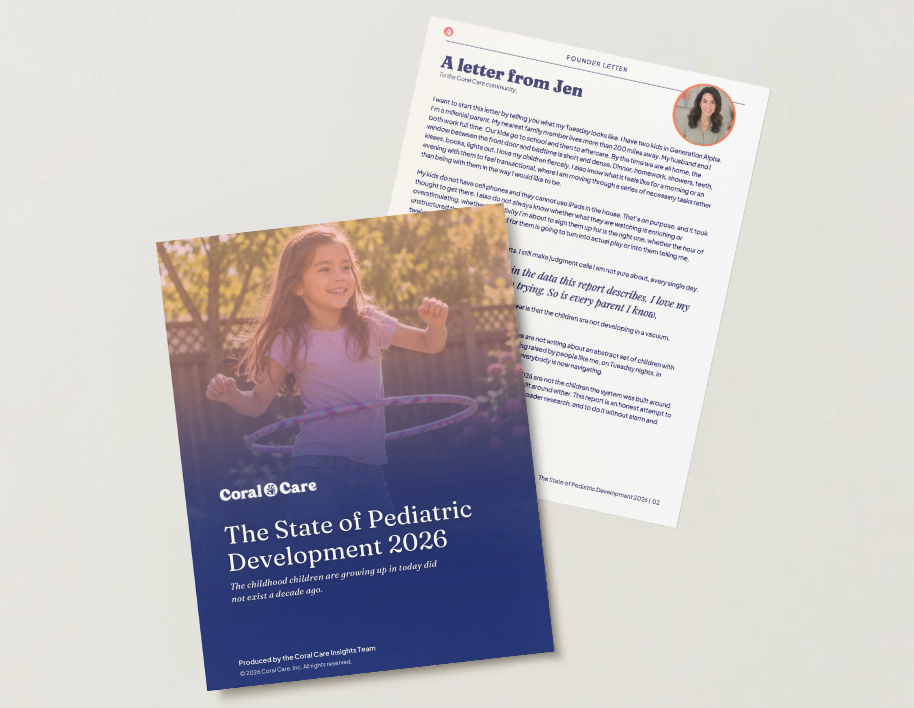
A letter from Jen

To the Coral Care community,

I want to start this letter by telling you what my Tuesday looks like. I have two kids in Generation Alpha. I'm a millennial parent. My nearest family member lives more than 200 miles away. My husband and I both work full time. By the time we are all home, the window between the front door and bedtime is short and dense. Dinner, homework, showers, teeth, kisses, books, lights out. I love my children fiercely. I also know what it feels like to move through them as a series of necessary tasks.

My kids do not have cell phones and they cannot use iPads in the house. That's on purpose, and it took thought to get there. I also do not always know whether what they're watching is enriching or overstimulating, or whether the hour I just protected is going to turn into actual play, or into them telling me, twelve times, that they're bored. I read the research. I follow the experts. I still make judgment calls I am not sure about, every single day.

I am one of the parents in the data this report describes. I love my children. I am tired. I am trying. So is every parent I know.

The most important thing we learned this year is that children are not developing in a vacuum. Childhood itself has changed. When we write about pediatric care in 2026, we are not writing about an abstract set of children with abstract families. We are writing about kids being raised by people like me, on Tuesday nights, in conditions nobody fully designed but everybody is now navigating.

This report is an honest attempt to describe what we are seeing in our data and in the broader research, and to do it without alarm and without performance.

With gratitude,

The State of Pediatric Development 2026 — report cover and founder letter

The full report · free

Read the whole story.

Forty pages of findings, methodology, and a letter from our founder — the data behind every claim on this page, in one place.

  • A letter from Jen Wirt, founder & CEO
  • The argument in four moves, with full data
  • How we read three datasets at once
  • Methodology & full source notes

Enter your email and we will send the full report straight to your inbox.

Find care

Ready to find support for your child?

In-home care, covered by insurance. No referral needed. Our Care Concierge team is ready to help you find the right therapist.