
Coral Care content is reviewed and approved by our clinical professionals so you you know you're getting verified advice.
Find effective support for developmental delays, quickly.

Concerned about your child's development?
Our free screener offers guidance and connects you with the right providers to support your child's journey.
A mirror is one of the cheapest and most useful things in a baby's day. It needs no batteries, it does not get stale the way a single-function toy does, and most families already own one. Pediatric physical therapists, occupational therapists, and speech-language pathologists all reach for mirrors during home visits, usually for completely different reasons.
Here is what mirror play actually builds, when babies work out that the baby in the glass is them, and how to set it up safely.
When do babies recognize themselves in the mirror?
It happens in stages, and the stage most parents are waiting for arrives later than they expect.
The first six months: a face, not a self
Young babies love mirrors and have no idea they are looking at themselves. What holds their attention is the face. Faces are the most compelling thing in a newborn's visual world, and a mirror produces one on demand, at close range, that moves whenever they do.
Six to twelve months: the baby in the glass is a friend
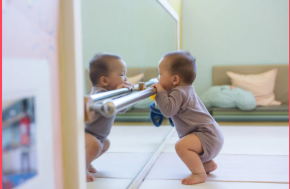
Most babies this age treat the reflection like a playmate. They smile at it, reach for it, pat the glass, and often peer around the back of the mirror looking for the baby who must be hiding there. That searching is a good sign. It means your baby understands the reflection is connected to something real.
The second year: self-recognition
Somewhere in the second year this shifts, and the clearest signs are physical rather than verbal.
Instead of reaching for the reflection, a toddler starts using it. They watch their own hands while they move them. They spot something behind them in the mirror and turn to the real object instead of the glass. They notice something on their face or in their hair and reach for themselves.
Occupational therapists call the underlying skill body awareness, meaning the sense of where your body is and what it is doing. A mirror is one of the few places a young child can check that internal sense against what they actually see.
Pediatric physical therapists watch for the same shift in movement. A toddler who knows the reflection is theirs starts correcting to it: widening a stance, catching a wobble, repeating a movement they liked watching.
Then there is the version every parent recognizes. Dancing at the mirror, making faces, narrating out loud. A child doing that has clearly worked out who they are looking at.
None of this runs on a schedule. There is real variation in when it shows up, and a child who is not doing it yet at twenty months is almost always fine. Self-recognition is one thread in a much larger picture of development, not a box to tick by a certain birthday.
What mirror play builds
Cause and effect. A mirror is one of a baby's first clean lessons in it. I move, and that baby moves at exactly the same moment. I open my mouth, that mouth opens. The link between action and result is perfectly reliable, which is what makes it worth testing over and over.
Sustained attention. Because the reflection responds to whatever the baby does, it holds interest longer than a toy that performs the same trick every time. Longer stretches of focused attention are worth having at any age.
Body awareness. A baby watching their own hand move in a reflection is doing real work to connect what they feel with what they see. That connection sits underneath a surprising amount of later skill, from getting dressed to handwriting.
Face reading. Babies learn to read emotion long before they can name it. A mirror lets them study expressions, including their own, with no social pressure and no one waiting for a response.
Shared attention. Get in the frame alongside your baby and it becomes a two-person activity. You are both looking at the same thing, taking turns, reacting to each other. That back and forth is the earliest form of conversation.
Mirror play and physical development
This is where mirrors do their most underrated work.
For young babies, it is mostly about tummy time. Lifting the head against gravity is how babies build the neck, shoulder, and trunk strength they need for rolling, army crawling, and creeping. It is hard work, and plenty of babies would rather not. A mirror at eye level gives them a reason to hold the position a little longer, which is exactly why it appears on our list of twelve PT-approved ways to make tummy time work.
Mirrors are also a genuine positioning tool. When a baby strongly prefers looking to one side, which is common and very treatable, placing something interesting on the side they are avoiding encourages them to turn that way. A mirror often holds attention better than a toy does. If your baby always looks the same direction or has developed a flat spot, it is worth reading about torticollis in babies and raising it at your next well visit.
There is a second benefit that parents rarely think of. When you are supporting your child from behind, a mirror lets you see their position. Our physical therapists rely on this constantly during home visits, and it is the easiest thing for a parent to copy. If you are helping your child practice standing or squatting from behind them, face a mirror so you can actually see what their knees and hips are doing. Mirrors sit alongside towels, pillows, and yoga mats on our list of household items that double as physical therapy equipment.
For older kids, occupational therapists put mirrors to work on strength and coordination. Handing a child a spray bottle and a cloth and letting them clean a mirror builds hand strength through the spraying motion and arm strength through big circular wiping, and it gets them reaching across their body. Tracing shapes on a fogged bathroom mirror works on similar ideas with a pre-writing focus. Both appear in our guide to occupational therapy activities for preschoolers.
Mirror play and talking
Speech-language pathologists use mirrors for a specific reason: they make an invisible process visible. Sounds are produced by the mouth doing things that are hard to see when you are sitting face to face with someone.
Sitting side by side at a mirror lets a child watch how mouths actually move, including their own. The version we recommend at home is deliberately low pressure. Talk and play normally, let your child see the mouths, and resist the urge to correct. Watching a good model does more than being asked to try again. There is more on this in our winter break skills guide.
What to try, by age
Zero to six months
- Prop a shatterproof mirror at eye level during tummy time, roughly eight to twelve inches away
- Hold your baby in front of a wall mirror and let them look at the two of you together
- Narrate what you see, naming body parts as you touch them
Six to twelve months
- Play peekaboo in the mirror, appearing and disappearing behind it
- Let them pat, mouth, and investigate a floor mirror during supervised play
- Hold a favorite toy where it shows up in the reflection and watch them work out where the real one is
Twelve to twenty-four months
- Make faces together and take turns copying each other
- Point out and name features, both theirs and yours
- Dance in front of the mirror, which builds balance, imitation, and plain enjoyment all at once
Two years and up
- Set up a dress-up corner with a securely mounted mirror. Dress-up play supports imagination, emotional expression, and body awareness, and a mirror gives kids visual feedback while they try things on. It is one of the zones in our playroom zone strategy
- Use the mirror for practice runs at brushing teeth, washing hands, and wiping faces
Mirror safety for babies and toddlers
Shatterproof only, always. For floor play, use acrylic or a mirror sewn into a fabric tummy time toy. No glass anywhere a baby can reach it, roll into it, or land on it.
Anchor anything larger than a toy. A leaning full-length mirror becomes a hazard the moment a baby starts pulling to stand. Mount it to the wall and anchor it. Do not prop it up and hope.
Check the condition regularly. Look for chipped edges, cracks, peeling reflective film, and loose frames or backing. A damaged mirror comes out of the play space rather than back into rotation.
Stay in the room. Mirror play is supervised floor play, not independent play, especially in the first year.
Keep mirrors out of the crib and sleep space. Safe sleep guidance is clear that cribs stay empty. A mirror is a play tool, not a sleep tool.
Expect mouthing. Babies will put their mouth on it. Wipe it down often and choose something you can clean easily.
When to check in with a clinician
Mirror play is not a screening tool, and no single mirror behavior tells you much on its own. That said, a few things are worth raising with your pediatrician or a pediatric therapist:
- Your baby does not seem to track faces or objects with their eyes
- Your baby's head consistently tilts to one side, or they strongly resist turning one direction
- A flat spot is developing on one side of your baby's head
- Your baby shows little interest in faces at all, yours included
- Your toddler is not using the mirror to guide their own movement by around two years old, alongside other things you have been wondering about
A missed milestone is a reason to ask a question, not a reason to panic. If you are wondering, the fastest route to an answer is usually an evaluation. Coral Care connects families with licensed pediatric physical therapists, occupational therapists, and speech-language pathologists who come to you and work in the rooms where your child actually plays. Get matched with a provider to get started.
Frequently Asked Questions
No. There is an old superstition about mirrors and babies, but there is no developmental reason to limit mirror play. A mirror is a low-stimulation, self-directed activity, and unlike a screen it responds only to what your baby actually does. Follow your baby's interest. When they stop engaging, move on. The one real limit is supervision rather than duration, since mirror play should happen with you in the room, especially in the first year.
A mirror is a useful tool here, but a strong one-sided preference is worth having looked at. Placing something interesting on the side your baby avoids encourages them to turn that way, and a mirror often holds attention better than a toy. That said, a consistent head tilt, real resistance to turning one direction, or a flat spot developing on one side of the head can point to torticollis, which is common, very treatable, and responds best to physical therapy started early. Mention it to your pediatrician rather than only working on it at home.
It can support it. Speech-language pathologists use mirrors because they make an otherwise invisible process visible. Sounds are produced by the mouth doing things that are hard to see when you are sitting face to face. Sitting side by side at a mirror lets a child watch how mouths actually move, including their own. Keep it low pressure: talk and play normally, let your child see the mouths, and resist the urge to correct. Watching a good model tends to do more than being asked to try again.
A shatterproof floor mirror or a soft fabric tummy time toy with a mirror panel sewn in. Position it at your baby's eye level, roughly eight to twelve inches from their face, which is about where young babies focus best. The point is to give your baby a reason to lift their head, so it needs to sit where they have to work slightly to see it. High-contrast black and white patterns around the mirror can help in the early months, since babies do not see the full color range yet.
Yes, with a few conditions. Use shatterproof acrylic or a mirror sewn into a fabric tummy time toy for any floor play, never glass. Anything larger than a toy should be mounted and anchored to the wall rather than propped against it, because a leaning full-length mirror becomes a tipping hazard as soon as a baby starts pulling to stand. Check regularly for chipped edges, cracks, peeling reflective film, and loose backing, and take damaged mirrors out of the play space. Keep mirror play supervised, and keep mirrors out of the crib and sleep space.
It happens in stages. For the first six months or so, babies love mirrors but are responding to a face rather than to themselves. Between roughly six and twelve months, most treat the reflection like a playmate, patting the glass and looking behind the mirror for the other baby. True self-recognition usually emerges somewhere in the second year, and the clearest signs are physical: watching their own hands move, spotting something behind them and turning to the real object, or noticing something on their own face and reaching for themselves rather than the mirror. There is a lot of normal variation in timing, and a child who is not there yet at twenty months is almost always fine.